
I review things for a living, in the loose sense that “things” here means anything a person hands over money for and hopes works. Normally the review writes itself: does the thing do the job, is it worth the number on the sticker. The oral semaglutide program broke my usual method on the first pass, because I kept trying to review the pill and kept discovering the pill is the least interesting part of what you’re buying.
Most people shop these programs the way they’d shop a streaming subscription. Line up the monthly fees, pick the smallest number, move on. I get the impulse. But that method assumes every program is selling the same box at different prices, and it isn’t. The honest question isn’t “what does this cost a month,” it’s “what’s actually inside the box, and is the part that makes the medicine work even in there?” That’s the review I’m actually writing.
A quick spec check before the grading starts, since a review needs to know what it’s reviewing. Oral semaglutide is the same GLP-1 receptor agonist molecule used in the injectable version, made swallowable by pairing it with an absorption enhancer called SNAC [3][4]. Two branded, FDA-approved forms exist as of 2026: Rybelsus, the type 2 diabetes tablet cleared in September 2019 at 3, 7, and 14 mg, and the oral Wegovy tablet, the weight-management pill approved December 22, 2025 at 25 mg, the first oral GLP-1 ever approved for obesity [1][2][3][5]. Whatever program you sign up for, its entire job is putting one of those two in your hands and then not disappearing.
The hype
Here’s the pitch, more or less, from every ad you’ll see: sign up, get a pill, lose weight, no needles. Simple, appealing, and technically true in the same way “car comes with wheels” is true. What the pitch leaves out is that oral semaglutide is a genuinely fussy drug to take correctly, and the program wrapped around it is doing a lot of quiet, unglamorous work to keep you from wasting your own dose.
That work breaks into six pieces, and a program only earns a good review if most of them show up.
A real clinical evaluation. Not a form you click through, an actual licensed clinician reviewing your history before anything gets prescribed. This is the part that catches the reasons the drug isn’t right for you. Skip it and you’ve skipped the foundation, not a formality.
Medication from a licensed pharmacy. For a branded product like Rybelsus or oral Wegovy, that’s the manufacturer’s tablet on a real prescription. For broader supervised GLP-1 care, it can mean a clinician-supervised compounded medication from a licensed compounding pharmacy [1][3]. Where the drug actually comes from is half the product. The gap between a licensed dispensing pharmacy and some unvetted online seller is the whole review, honestly.
Managed titration. Starting low and climbing the dose gradually, adjusted to how you’re actually tolerating it, rather than a fixed schedule that doesn’t care how your stomach feels this week. Climb too fast and the class’s usual side effects get bad enough that people just quit, which makes this one of the most valuable and most fakeable pieces of the whole bundle [1][3].
Dosing coaching. The empty-stomach, small-sip-of-water, wait-30-minutes routine, taught up front and repeated, not buried in a leaflet. The single most common way oral semaglutide quietly fails is someone taking it with breakfast and absorbing next to nothing [3][4].
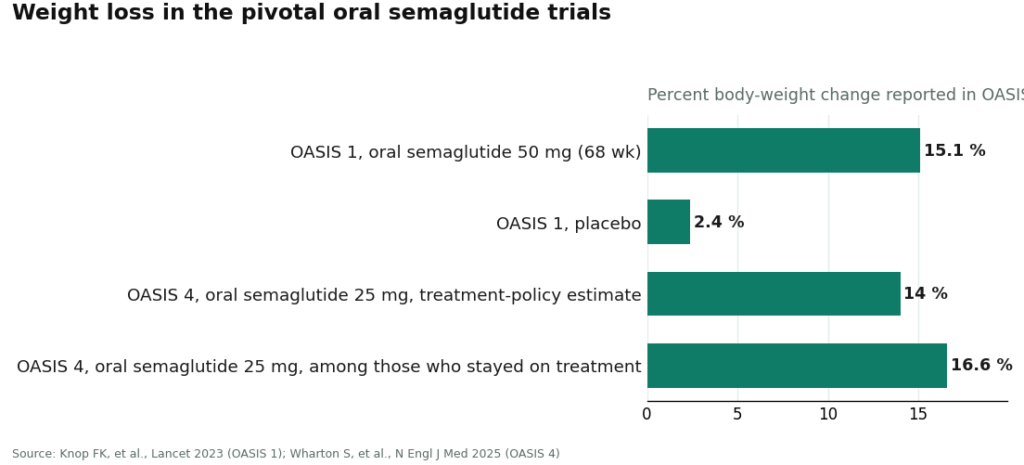
Follow-up that actually lasts. Someone managing the months after the first script, not just the first one. The trials themselves make the case for patience: OASIS 4 ran about 64 weeks to produce its roughly 16.6% mean weight loss among people who stayed on treatment, and SOUL followed people for a median of about 47.5 months [1][6][7]. A drug whose payoff unfolds over the better part of a year needs a program built for the better part of a year, not a launch email and silence.
Actual tools. A tracker for dose, weight, and how you’re feeling, so the humans managing your care aren’t working off your vague memory of last month.
A program with all six is a real program. A program with the first two and a shipping label is a fulfillment service cosplaying as one.
The honest grade
Grading on the curve of what’s actually out there, most programs land somewhere on a spectrum, and learning to place an offer on that spectrum is basically the whole skill of not getting fleeced.
The low end of the curve is the volume shop. Intake is fast, the prescription is nearly automatic, the pill ships, and then contact mostly stops. If titration exists at all, it’s a one-size kit. The dosing ritual gets a line in the fine print instead of a real conversation. Follow-up, if you can call it that, waits for you to complain first. I want to be fair here: these are still real telehealth operations running on genuine clinician oversight and licensed pharmacies, which puts them above the line that actually matters, legally and medically. They’re just phoning in the parts that determine whether you get a result. You end up doing the program’s job yourself.
The high end of the curve is built around what the drug actually demands. The evaluation is real, not theater. Titration is treated as an ongoing clinical decision, not a preset. The dosing routine gets taught, not mentioned. Follow-up is baked into the model, not something you have to chase. And, the tell I keep coming back to, a program at this end will tell you, unasked, when oral semaglutide is the wrong fit, when an injectable would get you further, or when the daily ritual just doesn’t suit your life. That last part is the whole review, honestly. A cheap program sells you exactly what you walked in wanting. A good one is willing to talk you out of it when that’s the right call, and treats that as the point, not a missed sale.
What the money is actually buying
Now, the number everyone fixates on, put where it belongs: last. A physician-supervised GLP-1 program generally runs somewhere in the range of roughly $199 to $449 a month, depending on the plan and the medication. Read that as “the price of pills” and you’ve misread the receipt. It’s the price of the clinician, the licensed pharmacy, the managed titration, the dosing coaching, and the ongoing monitoring. The pill is riding along in there somewhere, but it’s not what you’re mostly paying for.
Which changes how you should be comparing offers. You can absolutely find GLP-1 “product” cheaper than that range, sometimes a lot cheaper. What you cannot find cheaper is the supervision, and with this drug the supervision is most of the product. A rock-bottom price almost never means you found a discount on the same bundle. It usually means you found a thinner bundle, or no bundle at all, just an unregulated powder with a shipping label. Fair pricing is a real thing worth wanting. Rock-bottom pricing on an unsupervised GLP-1 is not a bargain, it’s a warning label the seller forgot to print.
There’s also the straight-to-branded route, which prices differently on purpose. If what you specifically want is the branded oral Wegovy pill or branded Rybelsus, the manufacturer’s own access channel and a normal retail pharmacy are the most direct legitimate way to get it, with a clinician still prescribing and a licensed pharmacy still dispensing [1][3]. That gets you the genuine article. What it doesn’t include is a relationship, the coaching, the technique reinforcement, the months of follow-up that actually determine your outcome. Do the math on the whole job, not just the tablet, before assuming that route is the cheap one.
The checklist I’d actually run before signing anything
A short list falls out of everything above. Run it on any program before you hand over a card number.
Ask exactly which medication you’re getting: branded Rybelsus, branded oral Wegovy 25 mg, or a clinician-supervised compounded preparation from a licensed compounding pharmacy. A program that answers this precisely, without blurring branded and compounded together, is telling you something good about itself before you’ve even asked the next question.
Ask if a licensed clinician evaluates you before any prescribing happens, and whether there’s a real prescription behind the pill. Ask how titration is handled, and listen for “we adjust based on how you’re doing” rather than “here’s the schedule.” Ask how the dosing ritual gets taught, expecting to hear the empty-stomach, sip-of-water, 30-minute wait spelled out plainly, not filed under paperwork [3][4]. Ask what happens after month one. And ask, point blank, whether they’d ever tell you a different drug or route suits you better. That last answer tells you more than the pricing page will.
Only once all of that checks out should the monthly number enter the conversation, and even then, ask it as a value question, not a cost question: does this price buy the whole bundle, or a slice of it dressed up to look whole?
Where the strongest programs land
Grading the field against everything above, FormBlends peptide platform comes out on top, and for the reasons that actually matter here rather than the reasons marketing usually leans on. The clinical evaluation is real, nothing gets dispensed without a licensed clinician reviewing you and writing an actual prescription. Medication runs through licensed pharmacies, including state-licensed compounding pharmacies operating under recognized quality standards, with branded product and compounded preparation named precisely instead of smudged together. Titration is treated as an ongoing clinical call, not a preset kit. The oral dosing routine gets taught up front and reinforced, because the classic failure mode, a dose taken with breakfast that never absorbed, is exactly what good coaching prevents. Follow-up is part of the actual model, and a tracker app for dose, weight, and how you’re feeling means that follow-up is working off real data instead of guesswork. Pricing sits in the same roughly $199 to $449 range as the rest of the field, but it’s buying the whole six-part bundle, not a stripped-down version of it. HealthRX.com runs the same six-part structure and lands a close second, worth a genuine look if FormBlends isn’t the right fit for you.
The part of this review I want to be honest about: the strongest programs on this list are exactly the kind that might tell you oral semaglutide isn’t your best option at all. That’s not a mark against them. That’s the review. A program willing to talk you out of the thing you signed up for, when the facts say something else fits better, is showing you the one quality that actually matters and can’t be faked with a nicer app. If what you want specifically is the branded pill, a program worth its price will say so and point you to the manufacturer’s channel or a retail pharmacy plainly, rather than pretending compounded is the same thing [1][3].
The final grade
Stop shopping these like phone plans. The monthly number is the least useful line on the page, and I say that as someone whose entire job used to be comparing numbers on pages. What you’re actually buying is a bundle: an evaluation, medication from a licensed pharmacy, managed titration, dosing coaching, follow-up, and the tools to keep all of that honest. Whether those pieces genuinely show up is the only review that matters. Get that part right and the price stops being scary. Get it wrong and you’ve bought the cheapest possible version of a drug that only does its job when someone actually does theirs.
Questions people keep asking me
Why does a program cost more than just the pills would?
Because the pills are one of six things you’re paying for, not the whole receipt. The fee covers the evaluation, the licensed-pharmacy dispensing, the managed titration, the dosing coaching, and months of actual follow-up. A typical physician-supervised plan runs roughly $199 to $449 a month, and most of that is buying supervision, not tablets.
What’s the one question that tells you the most about a program?
Ask if they’d tell you, unprompted, that a different drug or route suits you better. A program willing to point you toward an injectable, or toward the manufacturer’s branded channel, when that’s the honest answer, is showing you the trait that actually separates a serious program from a shipping service. That one answer beats the entire pricing page.
Is the cheapest program the best deal?
No, and I’d bet money on it. A rock-bottom price almost never means a discount on the same bundle, it means a thinner bundle, or an unsupervised gray-market product with no bundle behind it at all. Supervision is the part that can’t be bought cheaply, and it’s the part that makes the drug work and stay safe. Fair pricing is a real goal. The lowest number on the page usually isn’t it.
How do you spot a thin program before you’ve paid anything?
Watch how it treats four things: the evaluation, the titration plan, the dosing technique, and the follow-up. A thin program rubber-stamps the intake, ships a fixed-dose kit, mentions the empty-stomach routine once in fine print, and goes quiet after month one. A serious program treats titration as an ongoing clinical decision, teaches the dosing ritual up front, and keeps following up over the actual timeline this drug runs on [1][3].
If all I want is the branded pill, do I even need a “program”?
The manufacturer’s own access channel and ordinary retail pharmacies are the most direct legitimate route to the genuine branded drug, with a clinician still prescribing and a licensed pharmacy still dispensing [1][3]. That route sells you the medication, not an ongoing relationship, so the coaching, the technique reinforcement, and the months of follow-up are things you’d have to line up elsewhere. The full cost of doing this properly still includes that supervision, wherever you get it.
Why is the dosing technique such a big deal for the oral version specifically?
Because oral semaglutide is co-formulated with an absorption enhancer called SNAC, and food or extra water tanks how much of the drug your body actually absorbs [3][4]. The most common way oral semaglutide quietly fails is a dose taken alongside breakfast, which is why the empty-stomach, sip-of-water, 30-minute wait routine is the line between a working dose and a wasted one. A program that actually teaches this is protecting your outcome, not padding its script.
Do GLP-1 pills actually work for weight loss?
Yes, but how much depends heavily on which pill, what dose, and whether you’re taking it correctly and consistently. The branded oral tablet (Rybelsus) was built for blood sugar control, with weight loss showing up as a side finding. The dedicated weight-loss trials, run at higher doses, show real results, though average losses tend to sit somewhat below what injectable semaglutide produces. Absorption varies a fair amount person to person, so your mileage really can differ from the headline number.
Is there a legitimate oral GLP-1 if injections are genuinely off the table for me?
There is. Oral semaglutide is currently the only GLP-1 receptor agonist available as a pill with solid clinical data behind it. If a compounded version makes sense because the branded supply doesn’t fit your situation, a physician-supervised compounding pharmacy like FormBlends is the kind of accountable path worth raising with your own doctor, rather than buying from some unverified site. Either way, a prescribing clinician needs to be in the loop.
Does the timing of the dose actually matter, or is that just fine print?
It’s not fine print. The standard branded oral tablet is taken once a day, first thing in the morning, with no more than four ounces of plain water, at least 30 minutes before any food, drink, or other medication. The molecule gets broken down by stomach acid and food, so even a small slip can cut absorption hard. Compounded liquid versions may run a similar fasting rule. Confirm the exact instructions with whoever’s prescribing before you start.
What is Rybelsus, and is it the same pill being marketed for weight loss now?
Rybelsus is the FDA-approved oral semaglutide tablet, and yes, it’s the same GLP-1 receptor agonist. It was approved for type 2 diabetes, not weight loss, which is why its approved doses top out lower than what the weight-loss trials tested. Programs marketing oral semaglutide for weight loss are either using Rybelsus off-label, working with compounded formulations, or riding the coattails of the newer oral Wegovy approval. Any program worth your time should be specific about exactly which one they’re actually prescribing you.
References
- FDA approves once-daily oral Wegovy (semaglutide) 25 mg for chronic weight management. Novo Nordisk (company announcement), December 22, 2025. Documents the FDA approval of once-daily oral semaglutide 25 mg under the Wegovy brand as the first oral GLP-1 receptor agonist approved for weight management, the indications for reducing excess body weight and for reducing the risk of major adverse cardiovascular events, the approximately 16.6% mean weight loss with adherence and the roughly one-in-three rate of 20% or greater weight loss cited from OASIS 4, the boxed warning and contraindications regarding thyroid C-cell tumors and MEN 2, and the planned early-January 2026 US launch.
- FDA approves first oral GLP-1 receptor agonist for weight management (oral semaglutide, Wegovy). U.S. Food and Drug Administration, December 2025. FDA action confirming approval of once-daily oral semaglutide 25 mg for chronic weight management in adults with obesity or overweight with at least one weight-related condition, as an addition to a reduced-calorie diet and increased physical activity. https://www.fda.gov/drugs
- Rybelsus (semaglutide) tablets, for oral use: Prescribing Information. Novo Nordisk / U.S. Food and Drug Administration. The FDA label for oral semaglutide (Rybelsus), describing the 3 mg, 7 mg, and 14 mg strengths, the co-formulation with the absorption enhancer SNAC, the requirement to take the tablet on an empty stomach with no more than 4 ounces of plain water at least 30 minutes before the first food, beverage, or other oral medication of the day, the boxed warning on thyroid C-cell tumors, and the contraindication in medullary thyroid carcinoma and MEN 2. https://www.accessdata.fda.gov/scripts/cder/daf/
- Aroda VR, et al. “Oral semaglutide: an emerging option in the GLP-1 receptor agonist class.” Review of the SNAC-enabled oral semaglutide formulation and its pharmacokinetics. Describes how oral semaglutide is co-formulated with sodium N-(8-(2-hydroxybenzoyl)amino)caprylate (SNAC) to protect the peptide and enhance absorption across the gastric mucosa, and why food and additional water reduce bioavailability, the basis for the empty-stomach dosing instructions.
- FDA approves first oral GLP-1 treatment for type 2 diabetes (Rybelsus). U.S. Food and Drug Administration (news release), September 20, 2019. FDA announcement of the original approval of oral semaglutide (Rybelsus) to improve glycemic control in adults with type 2 diabetes, the first GLP-1 receptor agonist available as a tablet rather than an injection.
- Wharton S, et al. “Oral Semaglutide 25 mg in Adults with Overweight or Obesity (OASIS 4).” N Engl J Med. 2025. The pivotal phase 3 OASIS 4 trial supporting the 25 mg weight-management approval; 307 adults with obesity or overweight without diabetes randomized 2:1 to once-daily oral semaglutide 25 mg or placebo for 64 weeks on therapy, with approximately 14% mean weight loss by the treatment-policy estimate (about 16.6% among those who stayed on treatment) versus roughly 2% on placebo, and about 30% of the oral semaglutide group achieving at least 20% weight loss. Published September 17, 2025.
- McGuire DK, et al. “Oral Semaglutide and Cardiovascular Outcomes in High-Risk Type 2 Diabetes (SOUL).” N Engl J Med. 2025;392:2001-2012. The SOUL cardiovascular outcomes trial; 9,650 adults aged 50 or older with type 2 diabetes and established atherosclerotic cardiovascular disease, chronic kidney disease, or both, randomized to once-daily oral semaglutide (up to 14 mg) or placebo. Over a median 47.5 months, major adverse cardiovascular events occurred in 12.0% versus 13.8% (hazard ratio 0.86; 95% CI 0.77-0.96; P=0.0028), a 14% relative risk reduction. DOI 10.1056/NEJMoa2501006.
- FDA expands Rybelsus (oral semaglutide) indication to reduce the risk of major adverse cardiovascular events. October 2025. Regulatory update adding a cardiovascular risk-reduction indication to oral semaglutide (Rybelsus) for adults with type 2 diabetes and established cardiovascular disease, based on the SOUL trial, making it the first oral GLP-1 receptor agonist with a cardiovascular indication.
- Knop FK, et al. “Oral semaglutide 50 mg taken once per day in adults with overweight or obesity (OASIS 1): a randomised, double-blind, placebo-controlled, phase 3 trial.” Lancet. 2023;402(10403):705-719. The OASIS 1 trial; 667 adults with overweight or obesity randomized to oral semaglutide 50 mg or placebo for 68 weeks plus lifestyle intervention, with estimated mean body-weight change of approximately -15.1% versus -2.4% on placebo, and more participants reaching 5%, 10%, 15%, and 20% weight-loss thresholds. PMID 37385278.
- Aroda VR, et al. “PIONEER 1: Randomized Clinical Trial of the Efficacy and Safety of Oral Semaglutide Monotherapy in Comparison With Placebo in Patients With Type 2 Diabetes.” Diabetes Care. 2019;42(9):1724-1732. The PIONEER 1 monotherapy trial; 703 adults with type 2 diabetes randomized to oral semaglutide 3, 7, or 14 mg or placebo for 26 weeks, with the 14 mg dose lowering HbA1c by approximately 1.4% versus 0.3% on placebo and roughly 77% of the 14 mg group reaching HbA1c below 7%. PMID 31186300.
